The Overthinking Loophole
How one small decision can change your direction
By Sophie Toth ·
Have you ever wished you could simply switch your mind off?
Not sleep. Not distract yourself. Just experience a few moments where your brain isn’t analysing, predicting, replaying or preparing for something that hasn’t even happened yet.
I have.
For years, I was a classic overthinker.
My mind was constantly working. I could analyse the smallest interaction for days, sometimes weeks. I would replay conversations, question what I had said, think about what somebody else might have meant and map out countless possible scenarios.
And, unsurprisingly, the scenarios my mind created were rarely the positive ones.
They were usually the worst-case versions.
What if this happens?
What if I make the wrong decision?
What if they think this?
What if everything goes wrong?
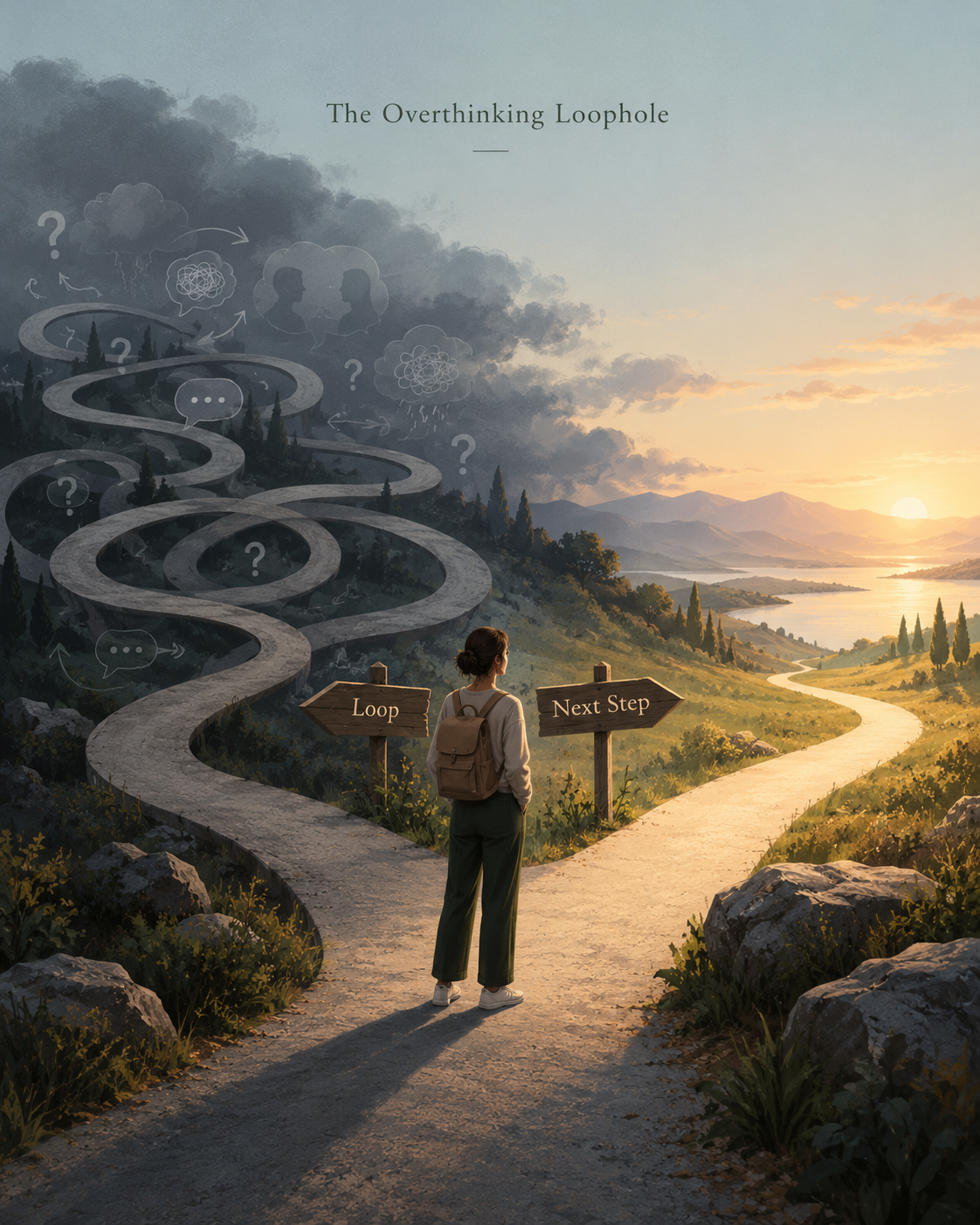
Overthinking can create a strange loophole in your life.
You think you are protecting yourself by considering every possibility. You believe that if you analyse something long enough, eventually you will find certainty.
But certainty rarely arrives.
Instead, you create more possibilities to analyse.
One thought creates another.
One scenario creates five more.
And before you realise it, you are no longer experiencing your life. You are experiencing your projection of what your life might become.
I had stopped trusting myself
One of the biggest things I realised later was that all this analysis had slowly drowned out something incredibly important: my intuition.
I was thinking so loudly that I couldn’t hear myself anymore.
Decisions that should have been relatively simple became complicated. I questioned my reactions. I struggled to express myself in the way I wanted to. I became anxious about situations that hadn’t even happened.
And sometimes I made the wrong decisions, not because I didn’t know what I wanted, but because I was making choices based on fear of an imagined future.
I wasn’t responding to what was actually happening.
I was responding to the worst scenario my mind had constructed.
That is the danger of the overthinking loophole.
The brain creates a problem.
Then it tries to solve the problem it created.
Then it analyses whether the solution was correct.
And the cycle begins again.
When your own mind becomes exhausting
There were moments when I genuinely wanted a “nothing box”.
Somewhere mentally silent.
Because constant thinking is exhausting.
There were times when the analysing followed me into my dreams. My brain seemed to continue working even while I was supposed to be resting.
Eventually, I didn’t really feel like myself.
I felt anxious about too many things. I couldn’t always communicate the way I wanted to. I questioned my decisions. I spent enormous amounts of mental energy trying to predict outcomes I could never completely control.
Eventually, I burned out.
And that became my wake-up call.
The unexpected introduction to coaching
At the time, I knew about mental health. Conversations around wellbeing were becoming more visible.
But I knew very little about coaching.
A friend suggested it to me.
Eventually, I decided not only to experience coaching but to learn more about the methodology behind it.
That decision changed something fundamental for me.
It didn’t magically remove every difficult thought from my life. I still think deeply. I still analyse. That is part of who I am.
But I learned something far more useful:
I didn’t have to believe or follow every thought my mind produced.
I could stop.
Question it.
Look at what was actually happening.
Separate fact from fear.
Recognise the patterns behind my thinking.
And then decide what I wanted to do next.
Those practices gradually became part of the way I manage everyday life, pressure and stress.
A few years earlier, I wouldn’t have imagined that was possible.
Sometimes momentum begins with a micro-decision
We often imagine changing our lives through enormous decisions.
Leaving the job.
Starting the business.
Moving somewhere new.
Ending the relationship.
Beginning again.
But I increasingly believe some of the most important changes start much smaller.
A micro-decision.
Do I react immediately — or give myself ten minutes?
Do I keep analysing this, or accept that I already have enough information?
Am I responding to what is happening, or what I am afraid might happen?
Is this thought helping me move forward, or keeping me in the same loop?
A tiny decision can interrupt a pattern.
And another good decision can follow it.
Then another.
That is how momentum can begin.
Not necessarily through one dramatic transformation, but through small moments of awareness followed by intentional action.
Clarity creates movement. Movement creates evidence. Evidence builds confidence. Confidence creates more movement.
That is the kind of momentum that can gradually change a life.
Why I created The Drift Map
My own experience is one of the reasons I wanted to create something that could gently help people see where they are before telling them where they should go.
That became The Drift Map.
It isn’t designed to diagnose you or tell you that something is wrong with you.
It is a self-reflection method designed to help you step outside the noise for a moment and look at your life more clearly.
Where are you aligned?
Where are you stuck?
Where might fear, inconsistency or uncertainty be influencing your decisions?
Where are you already creating momentum without recognising it?
And what might be the next small move?
The Drift Map combines structured self-reflection with The Self methodology, with coaching conversations available for people who want to explore what they discover more deeply.
Because sometimes we don’t need somebody else to give us the answer.
We need the right questions so we can finally hear our own answer again.
The first step doesn’t have to be huge
I have become a strong advocate for the coaching experience, but also for something broader:
Taking care of your inner world with the same intention you give to your outer life.
We spend enormous amounts of energy managing careers, homes, finances, relationships, appearance, schedules and responsibilities.
But the place from which every single one of those decisions is made is our mind.
That deserves attention too.
The first step is rarely the easiest one.
But the reward can be far greater than the discomfort of beginning.
So if you recognise yourself somewhere in this article, start small.
Take the Drift Type exercise.
Don’t use it to judge yourself.
Use it to become curious about yourself.
Because the moment you can see the pattern, you have something incredibly powerful:
a choice.
And sometimes one conscious choice is all you need to begin creating momentum in a completely different direction.
You don’t need a new life. You need a new direction.
Disclaimer
The Self Coaching provides non-clinical coaching and self-reflection tools. It is not a substitute for medical, psychological or mental-health treatment. If anxiety, burnout or persistent thoughts are significantly affecting your everyday life, consider speaking with an appropriately qualified healthcare or mental-health professional.